 Acer File Extensions |
Advent 7098 Laptop
Specification
| CPU | Intel Pentium M 735 1.70Ghz |
| Chipset | Intel i915PM |
| Memory | 1GB 400/533MHz DDR2 SDRAM SODIMM (2 memory slots. Max 2GB) |
| Hard Drive | 60GB Hitachi Travelstar HTS421260H9AT00 ** |
| CD Drive | Phillips SDVD8441 DVD+/-RW |
| Screen | 15.4" Widescreen TFT (1280x800) |
| Video Card | Intel 915GM (128MB shared) |
| Sound Card | Realtek ALC260 HD Audio system |
| Modem | Motorola SM56 modem |
| Network Card | Realtek 8139/810X (onboard) Intel Pro 2200BG wireless LAN * |
| PC Card | 1x Type I/II |
| Ports | 1x Microphone 1x Headphone 4x USB 2.0 1x IR 1x IEEE1394 (FireWire) 1x PC Card 1x Card Reader 1x Kensington Lock 1x LAN 1x Modem 1x VGA 1x S-Video (TV-Out) |
| Touchpad | Synaptics Touchpad |
| Power Supply | Lite-On PA-1900-05 |
| Battery | Simplo SQU-203 (14.4v 4800mAh) 4UR18650F-2-QC-KN1 (14.8v 4800mAh) |
| Dimensions | 34.2 x 363 x 266 (HxWxD in mm) |
| Weight | 2.75kg |
| Made By | Quanta KN1 |
* Use button to right of power button to switch wireless on/off.
** May have a 60GB Fujitsu MHT2060AT hard drive fitted instead.
Drivers
Your laptop should have a backup copy of all the drivers, you can find it by browsing to the c:\applications\drivers folder.
You can also download the user manual and a disassembly guide from the UKT Support site.
Memory Upgrades
To install a memory upgrade module follow these steps:
- Turn off power to your notebook PC using the power switch, disconnect the power adapter, and/or remove the battery pack
- Place your notebook PC upside-down on a clean work surface
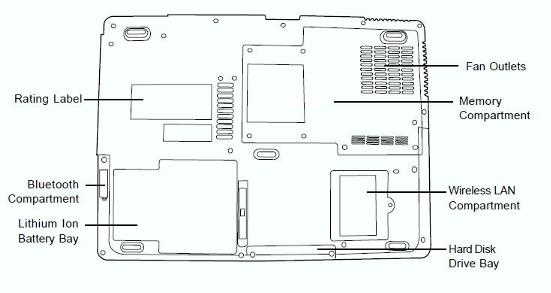
- Remove the screws holding the memory compartment cover (see Bottom of Laptop section below)
The memory upgrade module can be severely damaged by electrostatic discharge (ESD). Be sure you are properly grounded when handling and installing the module.
- Align the connector edge of the memory upgrade module, chip side up, with the connector slot in the compartment
- Insert the memory upgrade module at a 45 degree angle and press it firmly onto the connector
- Press the memory upgrade module down into the compartment until it locks into the retaining clips on either side. You will hear a click when it is properly in place
- Replace the cover and screw that were removed previously. Installation of the new memory module is now complete
Bottom of Laptop
Function Keys
Fn + F1 - Put notebook into hibernation mode
Fn + F2 - Enable/disable wireless (if available)
Fn + F3 - Toggle the display between LCD, CRT, LCD+CRT and TV
Fn + F4 - Decrease display brightness
Fn + F5 - Increase display brightness
Fn + F6 - Mute sound
Fn + F7 - Decrease volume
Fn + F8 - Increase volume
Fn + F9 - Play/pause CD playback
Fn + F10 - Stop CD playback
Fn + F11 - Back to previous track
Fn + F12 - Forward to next track
FN + ESC - Enable/Disable Bluetooth (if available)
In the Box
Disks Supplied
- Microsoft Works 8
Items Supplied
- Advent 7098 notebook
- LiteOn power supply. Output: 18.5V - 4.9A
- Mains power cable
- UK modem cable
Documentation Supplied
- Microsoft Windows "Start here" guide
Recovery Disc
Due to the nature of the recovery process you should not use FDISK or any other partition management software to delete the partition on your Advent computer. Doing so will prevent the recovery from functioning correctly.
Using the HDD Recovery System
Your Advent computer uses the latest recovery system that doesn't require any CDs or DVDs to restore your PC to it's original factory condition.
- There are two ways to start the recovery -
- Restart your computer. Then Press F10 repeatedly until the message "Starting System Recovery" is displayed.
- In Windows by clicking: Start / All Programs / System Recovery / System Recovery.
- The recovery will load and display a box with one option:
- Non-destructive recovery: this option will restore Windows, supplied applications, and drivers. This option will not destroy your documents or programs. These will be backed up along with the registry. These are restored at the end of the recovery process.
- System Recovery - No format: this will reinstall Windows, supplied applications and drivers. It will move your files to a folder called "My old disk structure". Any applications (except those supplied) will need to be reinstalled.
- System Recovery - Quick format: this option will erase your hard drive including your personal files. Windows, supplied applications and drivers will be reinstalled.
- Select the Non-destructive recovery option and press Next.
- You will be informed about System Restore in Windows, click Yes.
- The recovery will begin. Once this is complete click Restart.
Additional information
Press the ALT and D keys at the recovery menu to access a command prompt. This will allow access to C: drive. The command prompt will default to c:\minint\system32 where you can run a variety of tools including CHKDSK.EXE.
Reinstalling applications
From version 2.x of the recovery system onwards you can install applications from the c:\applications folder. Drivers can be installed from the c:\applications\drivers folder and utilities from the c:\applications\tools folder. You will still need to install Microsoft Works from the supplied CD.
Using the Recovery Media
If the HDD recovery doesn't work then you can recover from the discs you should have created. To use the discs (This will completely erase all your data) -
- Start the computer with the recovery CD or DVD in the DVD drive
- If the HDD already has the recovery partition in place, then you will get a screen with two options.
- Press ‘F’ . This will delete & recreate the recovery partition, then restore the user partition. Do not choose option 'R' at this screen. If you select ‘R’ from the recovery CD start-up options, then this will first check to see if the recovery partition is present on the HDD. If the recovery partition is on the HDD, then the PC will load into the recovery options screen from the recovery partition, and not from the recovery CD/DVD set.
- If a blank HDD has been put into the machine (or there are no partitions on the HDD), then you will only get the option to press 'R'. In this case, just press 'R' , and this will create the recovery partition.
- When all data is copied to the recovery partition, then the user partition is created and formatted.
How can I make a backup of the pre-installed software?
The Recovery Media Creator will remind you to create your recovery media every time you start Windows, unless you tell it to stop reminding you, dismiss it, or create the media.
To access the Media Creator start into Windows as usual, then Click Start / All Programs / System Recovery / Recovery Media Creator.
- You will be presented with a “Welcome” screen. Click Continue.
- You will be shown some information about the creation process. Click Continue and follow the on-screen instructions.
- Click Start Creation to create your System Recovery CD Set.
- The recovery creation software will advise you how many blank CDs/DVDs you will need to create your System Recovery set. A DVD has a much higher capacity than a CD and will require less discs.
- You will then be asked to insert a blank disc into your computer. Label this CD “Recovery CD 1” and then insert it into your DVD/CD Rewriter drive.
- Once you have inserted your blank disc the process should continue – If it does not, click OK to continue.
- The creation process will continue until you are prompted for a 2nd CD. Label this CD “Recovery CD 2” and then insert it into your DVD/CD Rewriter drive.
- Once the disc creation has completed you will see a “Congratulations” screen. Click OK and the program will exit.
- You have now created a complete set of Recovery disc(s) for your computer. These discs will allow you to restore your computer in case of any problems with your Windows XP software.
- Keep these discs in a safe place.
FAQ
How to Manually Run the Recovery Media Creator
If you've deleted the shortcut to Recovery Media Creator then don't panic. To run it manually open My Computer and browse to the C:\Windows\Creator folder and double click on CD Creator.